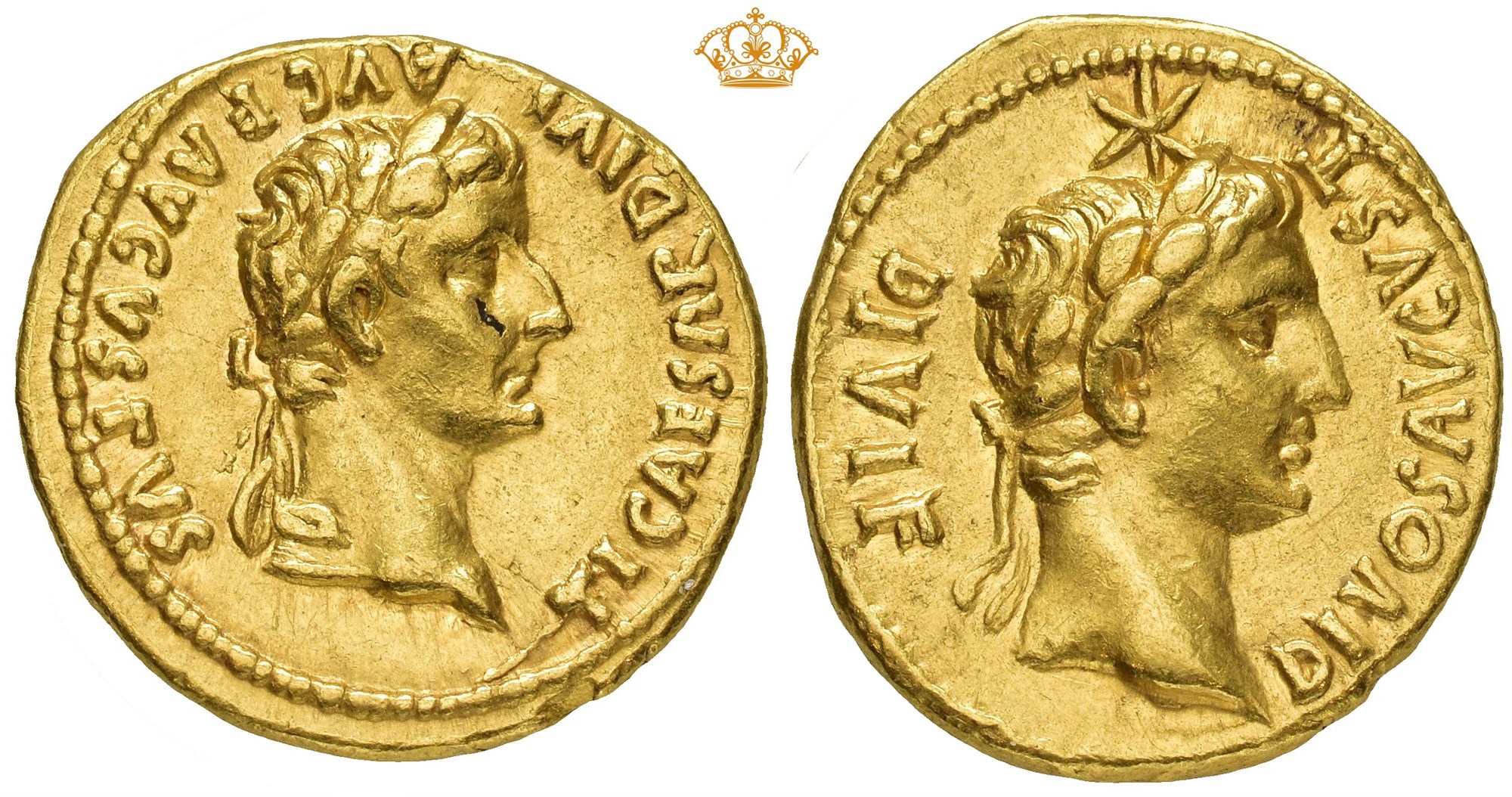
From Auction 42, 9 May 2026 — Tiberius aureus, 14–16 AD
There is something immediately arresting about this coin — not only in the portraits themselves, but in the small star placed above Augustus on the reverse. It is an understated detail, yet one that opens onto a larger history: the intersection of religious imagination and the very practical demands of political legitimacy.
The coin was struck in the years following Augustus’ death in 14 AD, at the outset of Tiberius’ reign — a moment when continuity was not merely desirable, but essential. Tiberius, Augustus’ adopted son and designated heir, assumed power on a solid constitutional footing. A long military and administrative career had established him as an experienced and capable ruler. Yet he remains, in many respects, a less self-defining figure than his predecessor. Where Augustus had shaped the office and its symbolic language from the ground up, Tiberius largely inherited and administered what had already been built.
The contrast is instructive. Augustus had entered public life as Octavian, the adopted son of Julius Caesar, in a period of civil war and open contest for power. Through the settlement with Caesar’s assassins and the conflicts that followed, he consolidated control incrementally. When he received the title Augustus in 27 BC, it marked not only the establishment of a new political order, but the emergence of a new form of authority — one grounded in tradition, controlled symbolism, and the suggestion of divine favour.
It is against this background that the coin should be read. The obverse presents Tiberius in the standard Roman idiom: laureate, with an idealized and composed expression. The reverse shows Augustus in comparable style, but with one significant addition: the star above his head.
This motif reaches back to the comet observed following Julius Caesar’s death in 44 BC, which was widely interpreted as a sign of his apotheosis. Pliny the Elder, writing in Naturalis Historia (II, 94), gives the observation a quasi-official form. The Latin text varies across editions, but the core reading runs:
sidus crinitum … per septem dies arsit … existimabaturque anima Caesaris in caelum recepti
— a long-haired star burned for seven days … and was held to be the soul of Caesar, received into heaven.
The boldness of the claim may partly explain why the transmitted text is not entirely stable. Yet the idea it carries proved remarkably durable: the soul of the great man ascending, the heavens confirming what politics had already asserted. The image became a fixed part of the Roman symbolic repertoire — appearing in Virgil, for instance, as the sidus Caesaris, the star of Caesar. By the time Tiberius struck this coin, it had passed from contested interpretation into something closer to institutional memory.
The logic the coin encodes is straightforward and effective: Caesar becomes a god; Augustus becomes the son of a god; Tiberius stands as the legitimate heir to that line. The star above Augustus is not merely commemorative — it functions as an active element in the new emperor’s claim to authority.
There is something distinctively Roman in this mode of expression. The coin does not argue its case; it states it. It presents an order in which the divine and the political are not in tension but mutually reinforcing, each lending weight to the other.
In this sense the aureus is more than a portrait coin. It is a concentrated statement of continuity and authority — and a reminder of how power in the Roman world could be anchored, and made legible, through symbols at once discreet and far-reaching.