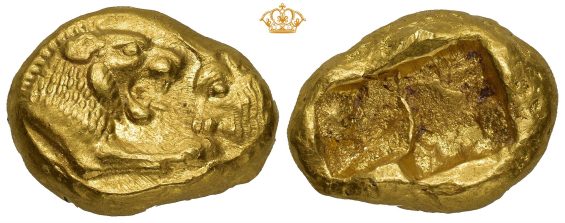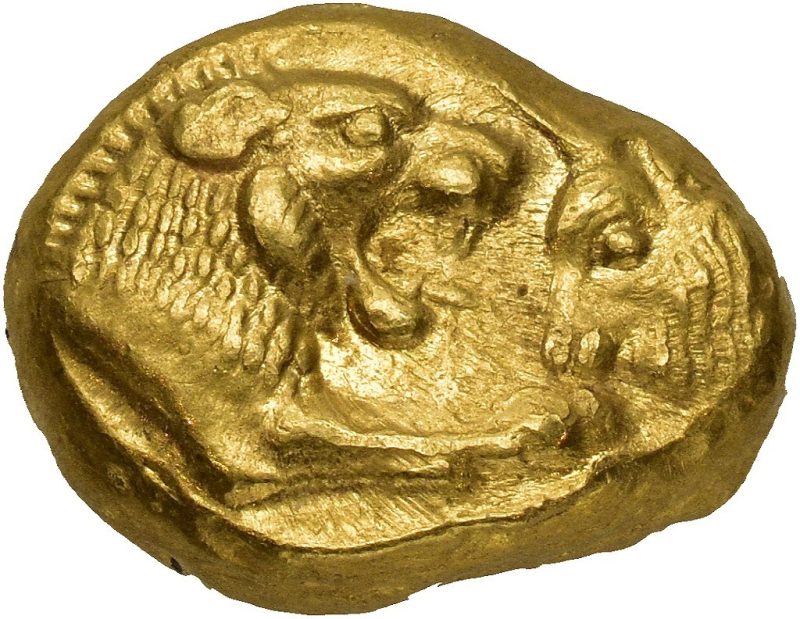
This gold coin was struck at Sardes, in present-day western Turkey, under King Croesus around 550–546 BC. It is a stater weighing 8.05 grams and carries one of the truly fundamental designs of early coinage: the Lydian lion facing the bull.
The lion already had a clear association with Lydian royal authority. Under Croesus, the lion and bull were combined into a fixed design used on both gold and silver coinage. Why these two animals were placed opposite one another is not known with certainty today, but the motif became the defining image of one of the most important early coin series.
A closer look also reveals how remarkable the die engraving is. Both animal heads are executed with considerable assurance and detail on a very small surface, without losing any of their visual force. The reverse carries the two simple square incuse punches characteristic of this early phase of coinage.
Croesus is also a name that has survived for more than 2,500 years. He is perhaps still best known through the expression “rich as Croesus”, a legacy of the stories surrounding his immense wealth as king of Lydia. Croesus himself challenged the rising Persian power, but lost. When Cyrus the Great, founder of the Persian Empire, conquered Lydia, the kingdom of Croesus came to an end.
And this coin has a starting price of NOK 60,000.
That is a considerable amount of money. But from a numismatic perspective, it is also remarkably moderate.
Here we are looking at a gold coin from an early and decisive phase in the history of money. It was issued by Croesus, a name that still survives in our language, and already represented a substantial and very real value more than 2,500 years ago.
Yet much younger coins can today sell for many times more — not necessarily because they are historically more important, rarer as a type, or more significant in the development of coinage, but because the difference between two examples may come down to a single grading point written on plastic.
It is precisely such contrasts that make numismatics so interesting.
Kingdom of Lydia, c. 680–546 BC
Gold stater struck under King Croesus, c. 550 BC
8.05 grams
Starting price: NOK 60,000
And this is only one coin.
Auctions 43 and 44 comprise more than 1,450 lots and offer a remarkably broad spectrum of what ultimately interests us all: numismatics.
Antiquity, the Middle Ages and the modern era. Kings and emperors, cities and states, trade and economics, war and peace, power and people — preserved in metal and paper.
Numismatics is history told through money.
As a numismatic auction house, we also want to open the door to other classic collecting fields, other periods and other coins.
We therefore encourage everyone who shares this interest to secure the catalogues for our Autumn Auctions 43 and 44. Not only to find the next object for a collection, but to browse, read, discover — and put them aside for another occasion.
Because numismatics is larger than the collection we already have.