
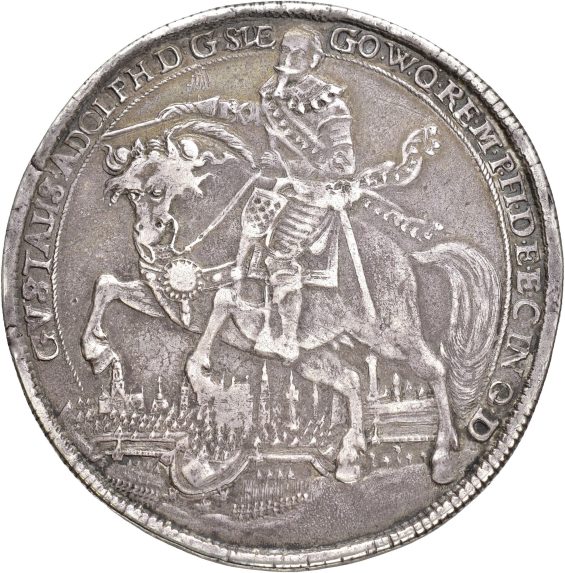
Only nine examples of this coin are known to exist, one of them for sale in our upcoming auction 42
That alone makes the 2 riksdaler of 1633 exceptional. But the number is almost the least interesting thing about it. The coin was struck posthumously — Gustavus Adolphus had died at the Battle of Lützen in November 1632 — and for a long time it was attributed to a mint in Augsburg, partly because Augsburg is precisely what appears in the background of the design: a walled city with towers and a gate, rendered in careful detail behind the king on his prancing horse. More recent research has changed that attribution. A small mark beneath the horse’s foremost hoof, identical to the signature of Marcus Kock — the mintmaster responsible for Stockholm’s output from 1633 — establishes the coin as a Stockholm product. The city in the background is Augsburg. The coin itself is Swedish, struck in the capital, in the year after the king who commissioned the design was killed in battle.
Why Augsburg
To a modern eye, Augsburg may seem an unlikely subject for a Swedish commemorative coin. In 1632 it was anything but peripheral. When Swedish forces occupied the city in April of that year, it marked the opening of the Bavarian campaign — the deepest and most ambitious push into Habsburg territory that Gustavus Adolphus would undertake. Augsburg was the last significant city before crossing into Bavaria, and its fall signalled that the Swedish army was not consolidating but advancing. The design choice was a statement. This was where the campaign turned south.
As Far South as Munich
What followed is one of the less widely known episodes of the Thirty Years War. Crossing the Lech river and defeating Imperial forces at the Battle of Rain, the Swedish army entered Munich in May 1632 — the Bavarian capital, deep in Catholic territory, over a thousand kilometres from Stockholm. No Protestant army had reached this far south since the war began in 1618.
Munich did not only represent a symbolic victory. The city yielded a treasury of considerable scale: contemporary accounts record seizures running to several hundred thousand Reichsthaler in coin, bullion, and silverware. Exact figures are disputed, but the sum was large enough to matter in operational terms.
A War Financed on the Move
This brings us to the most counterintuitive aspect of the Swedish campaigns in Germany, and the one that gives this coin its broader historical context. The Swedish crown could not finance a sustained war in the empire from domestic revenues alone. What made continued campaigning possible was a fiscal system assembled from several sources simultaneously: subsidies from France under the Treaty of Bärwalde, contributions extracted from occupied cities and territories, credit arrangements, and direct seizures of coin and bullion such as those obtained in Munich.
The French dimension deserves a moment’s attention. It was Cardinal Richelieu, in the name of the French king, who agreed in 1631 to fund a Lutheran king’s war against the Habsburg emperor — the man theoretically charged with defending Catholic Europe. Strategic interest overrode confession. France paid Sweden to fight Austria, and the money helped keep an army in the field.
The 2 riksdaler of 1633 sits at the intersection of all of this. It honours a dead king with a design rooted in his greatest campaign. It was struck in Stockholm from silver that had passed through a war economy stretching from the Baltic to the Bavarian Alps. And it survives in nine known examples — rare enough that each one carries the full weight of the story behind it.