
;)
The Smallest Denomination: The 1793 Half Cent at the Dawn of the United States Mint
When the United States Mint began operations in 1793, the young republic faced a practical need for small change. While gold and silver expressed sovereignty, it was copper that enabled everyday commerce. The half cent—valued at one two-hundredth of a dollar—became the smallest circulating denomination in United States history, and its first issue marks the beginning of a new national monetary system.
Several issues lay claim to the title of the first American coin. The Fugio cent of 1787 was the first authorized federal issue, while the 1792 half disme was the first struck under the new Mint legislation. It is nevertheless the 1793 half cent that represents the first coin struck at the first official United States Mint in Philadelphia.
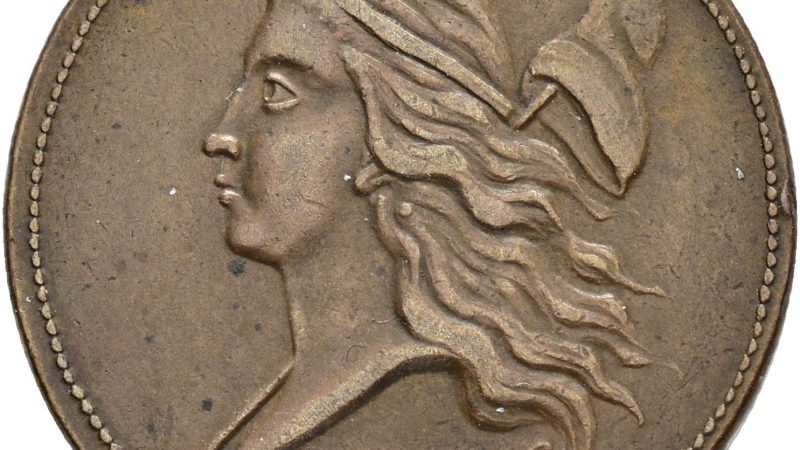
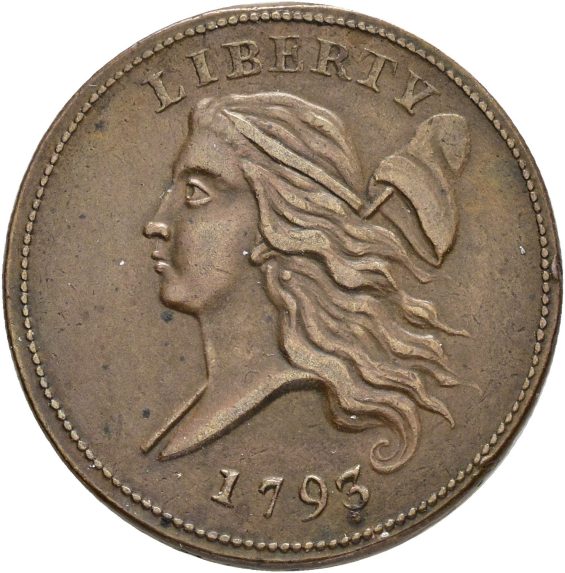
The 1793 half cent belongs to the Liberty Cap type, characterized by a left-facing portrait of Liberty with freely flowing hair, and a pole topped by a cap—the ancient pileus, a classical symbol of freedom. The motif has its roots in antiquity, where the cap was associated with manumission and civic status, and was later adopted more broadly as an emblem of liberty. The reverse features a simple wreath enclosing the denomination. By later standards the design appears crude, yet it reflects the experimental and urgent character of early American coinage.
Production took place under modest conditions at the Mint in Philadelphia. Planchets of varying quality were struck using screw presses powered by manual labor, and at times assisted by horsepower. The result was uneven striking and often weak details—features that today define early American copper coinage. In this early phase, the engraver Joseph Wrightwas also associated with the work; he died the same year during the yellow fever epidemic in Philadelphia, underscoring the fragility of the Mint’s beginnings.
From a metrological standpoint, the half cent was intended to weigh approximately 104 grains (about 6.74 grams), though considerable variation is observed. Its high copper content also made the coins susceptible to corrosion and wear, explaining the rarity of well-preserved examples.
The denomination reflects an economy in which even the smallest amounts held practical value. As prices rose and copper values increased, its usefulness gradually declined. Production became irregular, and the half cent was ultimately discontinued in 1857, well before the outbreak of the American Civil War.
A striking contrast is offered by the celebrated 1794 dollar, often regarded as the first United States silver dollar. An example was exhibited in Oslo in 2016 at the Historical Museum, and remains documented in the exhibition archive here:
794 Flowing Hair Dollar travels in Europe
The coin realized over ten million dollars at auction in 2013 and is considered one of the most valuable coins in the world.
The comparison is tempting: the half cent represented one two-hundredth of a dollar, and a strictly proportional reflection of a ten-million-dollar valuation would suggest a value of roughly $50,000. Yet numismatic reality rarely follows such simple arithmetic.
Instead, the 1793 half cent emerges as a more immediate historical expression—a coin of everyday exchange rather than grand transactions. Its significance lies not in spectacular auction results, but in its role as a foundation of a new nation’s monetary system.
An example of this historically significant denomination is offered in our upcoming auction.