 Tempus velut fluvius est rerum quae fiunt.
— Marcus Aurelius
Time is like a river of events.
The Roman emperor Marcus Aurelius once wrote that time is like a river of events. Most traces of peoples and kingdoms disappear in that current, yet a few objects survive the centuries. Among them are coins and medals—small pieces of metal that still carry the portraits, symbols, and memories of the societies that created them.
The history behind such objects is often far greater than what can be contained within a catalogue description. Each coin has its own story, its former owners, and its place within a broader historical context. Many of our clients actively contribute to preserving this history through their collections, and in doing so they themselves become part of the long narrative these objects represent.
Among the collections presented in this auction is a remarkable group of early speciedalers assembled by Johan Sættem. The series includes some of the most important issues struck after the discovery of silver at Kongsberg and represents the result of a collecting passion developed over several decades. We are grateful for the confidence Johan Sættem has shown in entrusting us with placing parts of this collection with new collectors, ensuring that the story may continue from one collection to the next.
Another significant collection in this auction is the group of Chinese banknotes assembled by Nils Henrik Sjø. Over many years, he built an extensive and distinctive collection reflecting both the dramatic history of China and the many connections between China and Scandinavia. After many years of preparation, we are pleased to present this collection in our auction catalogue.
With these and many other notable objects, we are proud to present Auction 42. The catalogue spans a wide numismatic landscape—from the ancient world to more recent coins, medals, and banknotes.
ANCIENT COINS
The ancient coin section is more concentrated than in previous catalogues, but no less interesting—quite the contrary. The section comprises around sixty coins, presenting a carefully selected range of historical issues from Persian gold to Byzantine solidi.
Among the highlights is a magnificent aureus struck under Emperor Otho during the dramatic months of AD 69, the so-called Year of the Four Emperors. Otho’s brief reign makes his coins among the most sought-after portrait issues of the Roman Empire.
Collectors of ancient coins can also look forward to our autumn auction, where we will present an extensive catalogue devoted almost entirely to ancient numismatics.
WORLD COINS
The world coin section comprises around 560 coins from the Middle Ages to modern times and spans a wide spectrum of minting traditions across many centuries.
With starting prices ranging from NOK 700 to NOK 700,000, and weights from under one gram to nearly 100 grams, the section reflects more than a thousand years of monetary history—from medieval city-states to powerful empires.
Among the coins represented are the first American half cent of 1793, a gold 10-ruble of Peter I of Russia, and, from present-day Ukraine, a silver srebrennik of Vladimir I—a ruler who also supported Olav Tryggvason. Here we encounter a seemingly endless stream of coins which, in the sense described by Marcus Aurelius, have flowed through the course of history before eventually finding their way into new collections.
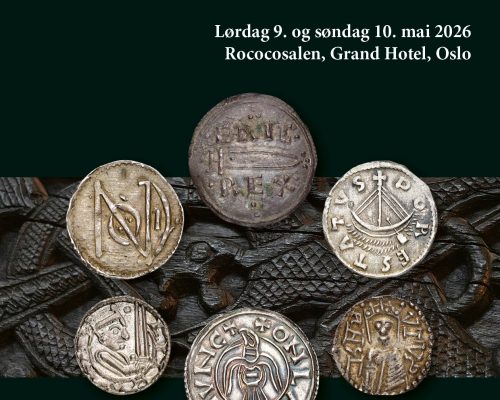
Another highlight is a group of around thirty-five Viking coins struck in Denmark and England. Particular attention will undoubtedly be drawn to a penny struck in York around 952–954 under the Norwegian Viking king Eric Bloodaxe, then ruler of Northumbria. Several of these coins also appear on the cover of the catalogue.
The section also contains more than one hundred ducat issues, ranging from single ducats to ten-ducat multiples, from Austria, the German states, Poland, the Netherlands, Denmark, and Sweden. These coins speak not only of trade and exchange across the centuries, but also of the splendour and privilege of Europe’s ruling houses.
MEDALS
The medal section presents another side of history—not through circulating coinage, but through commemorative medals struck to mark events, institutions, and individuals. Many of the medals were designed by Ivar Throndsen and provide a vivid glimpse into Norwegian civic and organizational life in the nineteenth century.
Among the highlights are medals connected to the Norwegian royal family, including the coronation of Haakon VII and Queen Maud in 1906, as well as the University’s King’s Gold Medal. The section also includes major European works, notably an impressive gold medal of 30 ducats from Mainz dated 1730—a rare, possibly unique piece of a size seldom encountered in medallic art.
Also worth noting is the Dutch Baroque medal commemorating the Battle of Bergen in 1665. It was struck in gratitude for the protection given to the Dutch merchant fleet in Bergen and represents a large and richly detailed work seldom encountered on the market.
NORWEGIAN COINS BEFORE 1874
This section opens with a small group of pennies from the reign of Olav Kyrre, all from the famous Måge hoard discovered in Hardanger in 1909. This is followed by, among other pieces, a bracteate bearing the letter X from the time of Sverre Sigurdsson, known from the Nes hoard, as well as a penny of Erik Magnusson with provenance dating back to 1987. Among the medieval coins, the very rare hvid struck in Nidaros under Archbishop Gaute Ivarsson also deserves particular mention.
The section then moves into the early modern period with the popular speciedalers of Christian IV. His son is represented by a small series of 2-mark coins from the collection of L. E. Bruun, offered at attractive starting prices—a rare opportunity for Norwegian collectors to acquire pieces with provenance from one of the most celebrated collections in Nordic numismatics.
Much attention will undoubtedly be drawn to the small 8-skilling of 1712 struck as a pattern coin, a piece many collectors would welcome in the regular coinage series.
Among the later issues, we may also highlight an uncirculated speciedaler of 1835 with particularly beautiful toning—the type collectors often refer to as genuine “rainbow toning.”
NORWEGIAN COINS AFTER 1873
The second part of the Norwegian coin section comprises coins from the period following the introduction of the krone system in 1873. Here we find a concentrated selection of classic collector coins from the union period and later.
Among the highlights are several coins in unusually fine condition, including an uncirculated 20-kroner gold coin of 1883, a 2-kroner of 1888 that will undoubtedly attract strong interest among collectors, and an attractive 50-øre of 1880—a better date seldom encountered in such quality.
BANKNOTES
Finally, the catalogue concludes with the section of Norwegian banknotes, offering a wide selection of what one would expect in a strong auction. Here we find notes from before 1877, Oscar issues, large denominations from the second and third series, as well as replacement notes and specimen issues.
The section also contains a substantial and interesting group of London issues, including 1, 2, 5, 10, and 100 kroner of 1942, as well as 10, 50, and 100 kroner of 1944. In addition, there are notes from Svalbard, as well as credit and rebate notes. Many collectors will surely find good opportunities here to fill gaps in their collections.
Finally, we would like to welcome you to the auction. As these objects once again change hands, they continue their journey in the stream of history—just as Marcus Aurelius described the passage of time.
We hope the catalogue will offer both discoveries and opportunities for collectors, whether one is searching for rare types, better grades, or the missing pieces in a collection.
We look forward to lively bidding—and, not least, to meeting collectors and friends of numismatics.
We look forward to welcoming you at the Grand Hotel, or as participant at the online auction.